What each piece of freediving kit does, and the differences that actually matter when you choose — low-volume masks, carbon versus fiberglass fins, open-cell wetsuits, rubber belts, and the right snorkel.
By Sascha Mombartz
Freediving gear is built around a single idea: do more with one breath. Everything you wear is trying to make you more efficient, more streamlined, or warmer — so you spend less oxygen getting where you want to go. That's why freediving kit looks different from scuba kit, even when the names are the same. Here's what you actually need, and what separates the entry-level version from the one you'll grow into.
Mask
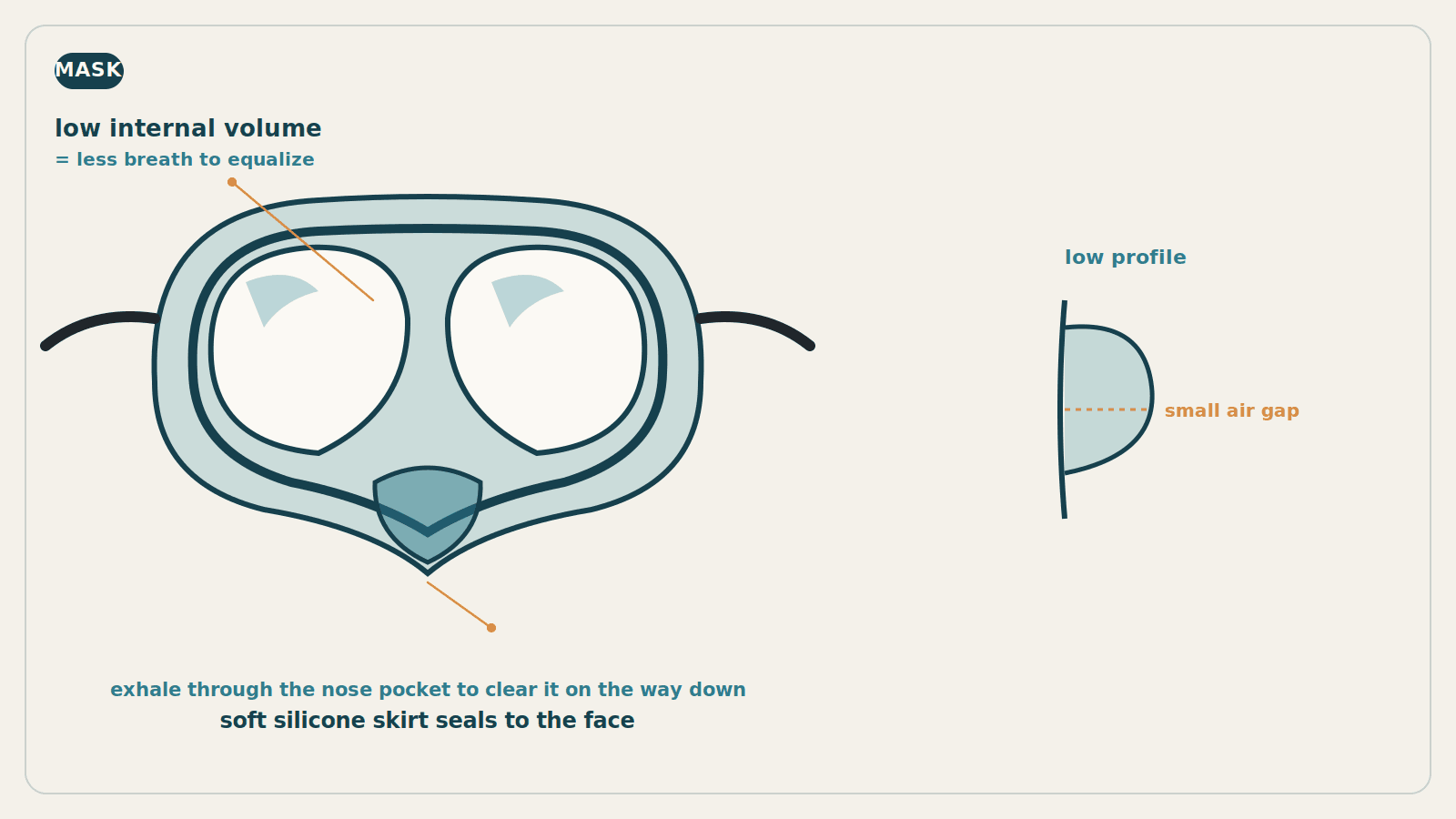
The defining feature of a freediving mask is low volume — a small internal air space that sits close to your face. Every meter you descend, the water pressure squeezes that air pocket, and you have to add air back by exhaling gently through your nose to keep the mask from clamping onto your face. Less air volume means less of your precious breath spent equalizing the mask, and a lower profile means less drag. That's the whole game.
Look for a soft, frameless or low-profile silicone skirt and a snug fit (press it to your face without the strap and inhale through your nose — it should hold). Tempered-glass lenses are standard. As you progress toward depth, some divers switch to a nose clip plus fluid goggles so they don't have to equalize a mask at all, but that's an advanced move — start with a good low-volume mask.
Leading options come from Cressi (the Nano and Minima are classics), Omer (Alien, Zero3), Mares (Viper), and Aqua Sphere. Most cost in the modest double digits, so this is a piece worth getting right early.
A low-volume mask keeps a small air space close to your face — less breath spent equalizing, less drag.
Snorkel
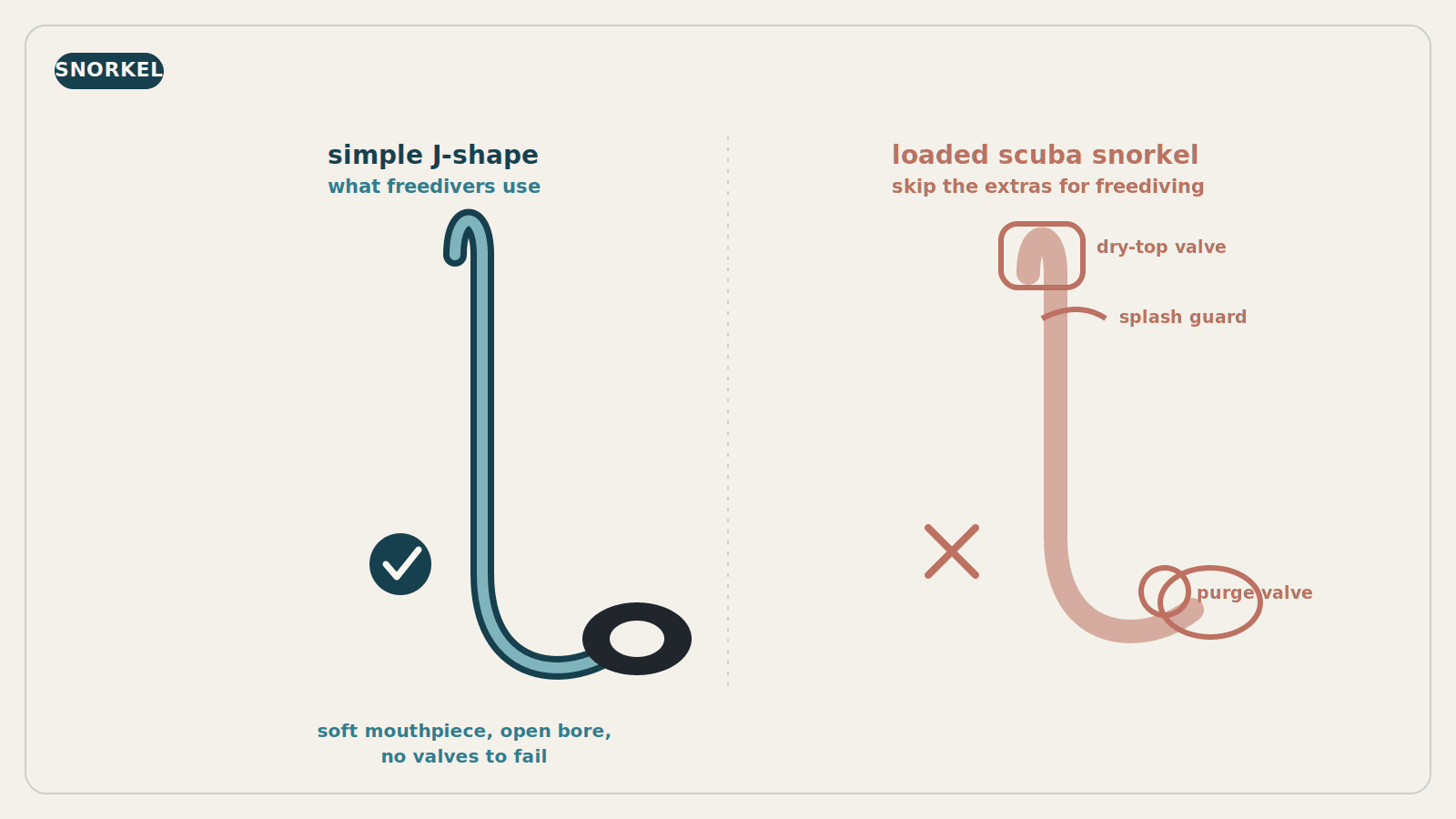
Counterintuitively, the best freediving snorkel is the simplest one: a plain J-shaped tube in soft silicone, with no purge valve, no dry-top float valve, and no splash guard. The reason is partly streamlining and partly safety — you breathe through it while you rest face-down at the surface, then take it out of your mouth before you descend. Diving with a snorkel clenched in your jaw adds tension and, in a blackout scenario, can interfere with rescue. Fewer moving parts also means nothing to fail or leak. Almost every dive brand (Cressi, Omer, Mares) makes a suitable bare-bones model; skip the feature-loaded scuba snorkels.
Freedivers prefer the plain J-shape; the valve-loaded scuba snorkel just adds parts you don't need.
Fins
Freediving fins are long-bladed — far longer than scuba fins — because a long blade moves more water per kick, so you get more distance for less effort and less oxygen. Most are a two-part system: a foot pocket and a separate, replaceable blade, which lets you upgrade the blade later. The big choice is blade material:
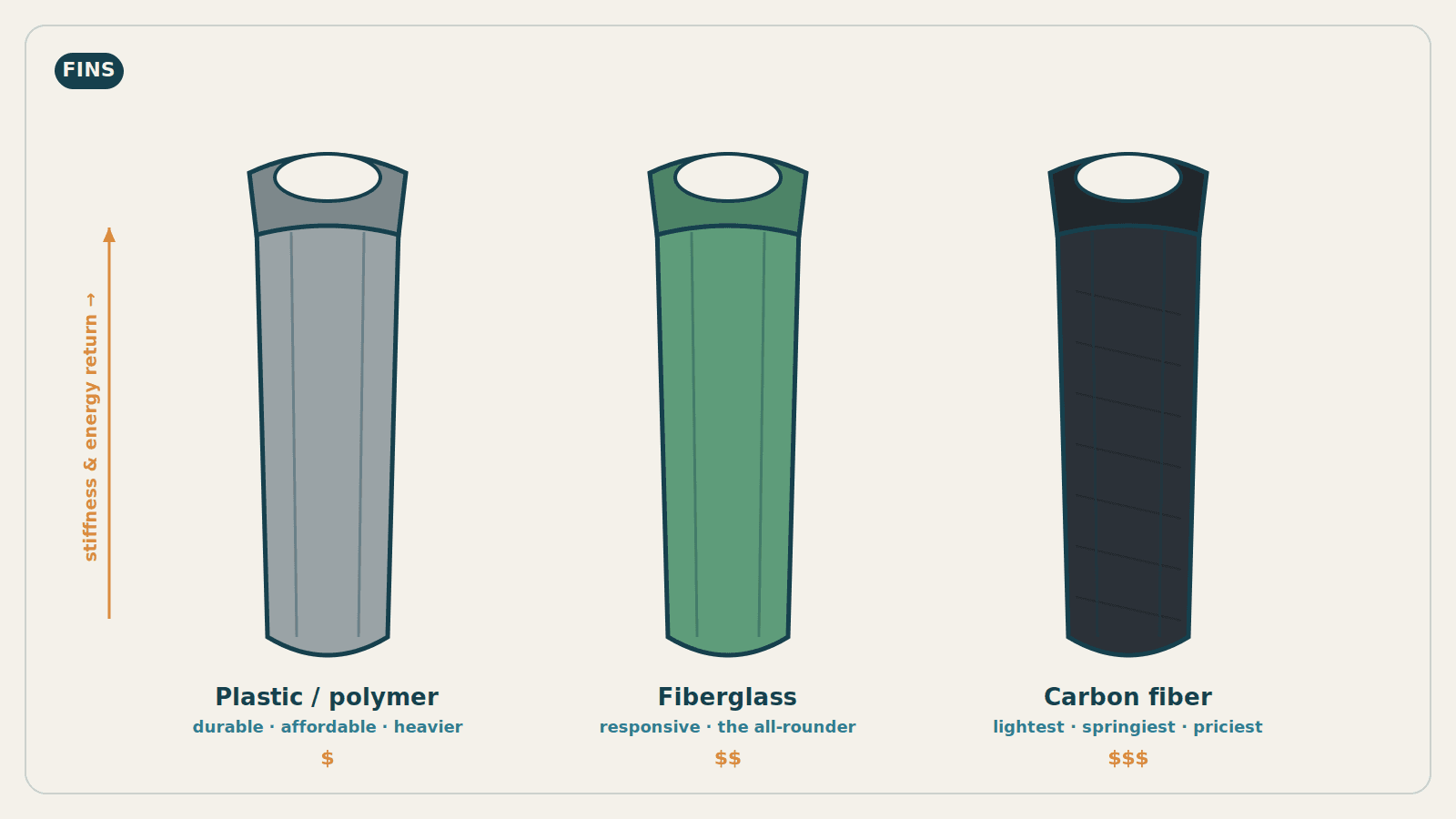
Plastic / polymer — affordable, nearly indestructible, and forgiving. Heavier and less efficient, but the right place to start while your technique settles. Cressi's Gara range is the perennial beginner pick.
Fiberglass — the sweet spot for most improving divers. Lighter and more responsive than plastic, with a lively flex and energy return, but more durable and far cheaper than carbon.
Carbon fiber — the lightest and most efficient, with the crispest snap and return. Also the most expensive and the most fragile (a hard knock against rock or a boat ladder can crack one). This is a serious-diver upgrade.
Blades also come in stiffness grades (soft, medium, hard); match it to your leg strength and how thick a wetsuit you'll wear, since a thicker suit makes you more buoyant and harder to kick. High-end blades come from C4, Molchanovs, DiveR, and Leaderfins, while Omer (Stingray, Eagle Ray) and Mares cover the mid-range well. Advanced pool and competition divers may move to a monofin — a single blade for both feet — which is more efficient but considerably harder to learn.
The same long blade in three materials: efficiency and price climb from plastic to fiberglass to carbon.
Wetsuit
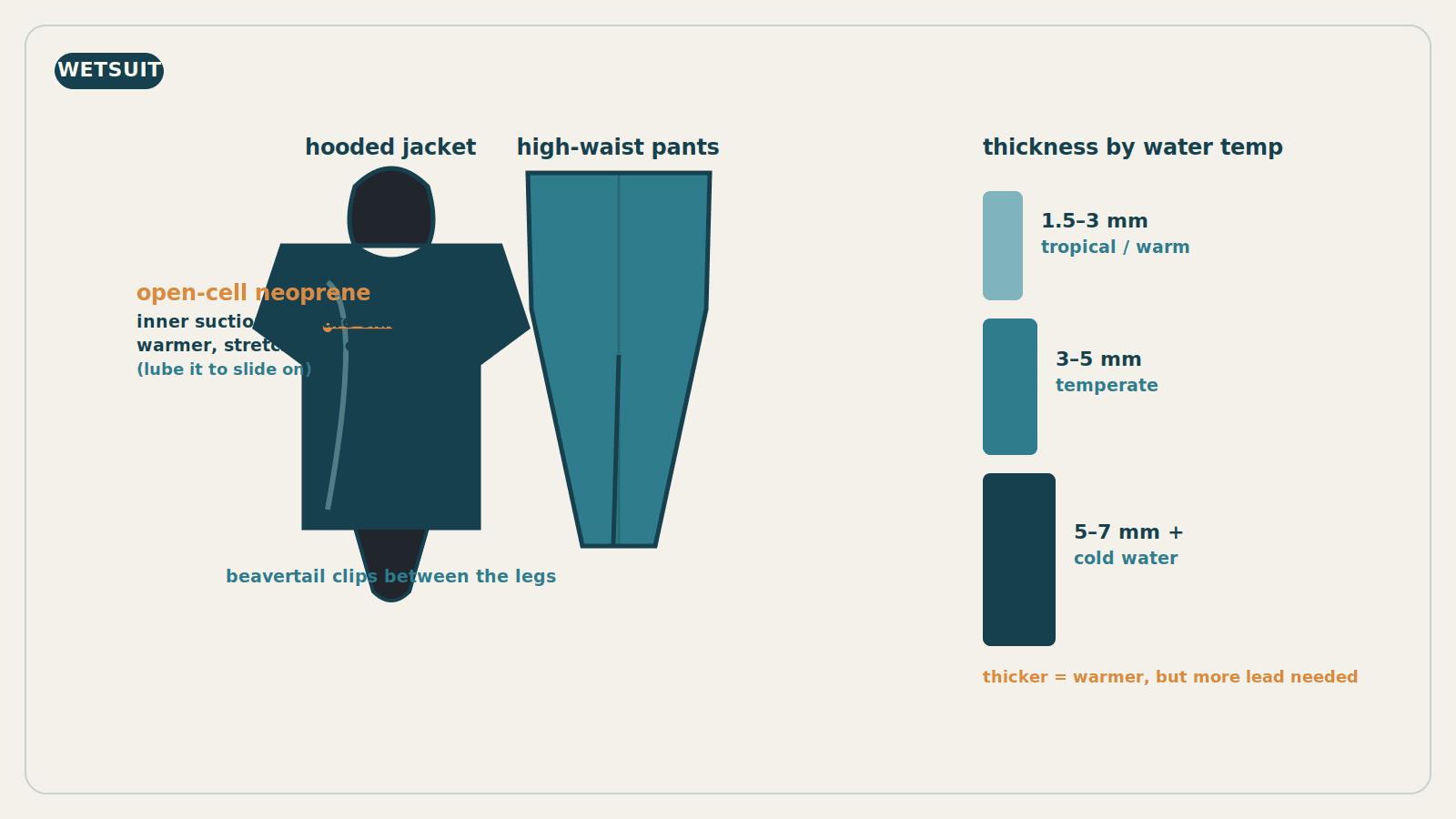
A freediving wetsuit does two jobs: keep you warm and keep you streamlined. Most are two-piece — high-waisted pants plus a hooded jacket with a beavertail that clips between the legs — with an open-cell neoprene interior. Open-cell neoprene is the spongy, un-lined inner surface that suctions directly to your skin: it's warmer and more flexible than a lined suit, but it tears easily and has to be lubricated (soapy water or conditioner) to slide on. The exterior is usually smooth-skin or a camo lining.
Pick thickness by water temperature: roughly 1.5–3 mm for warm, tropical water, 3–5 mm for temperate, and 5–7 mm or more for cold water. Thicker neoprene is warmer but more buoyant, which means more lead on your belt. Custom and made-to-measure suits (e.g. Elios) fit best, while Omer, Mares, Beuchat, Salvimar, and Molchanovs offer strong off-the-rack ranges. Japanese Yamamoto neoprene is the premium material to look for on a spec sheet.
A two-piece open-cell suit; thickness follows the water temperature.
Open-cell neoprene in its element. Photo: Maahid Photos / Unsplash.
Weights and belt
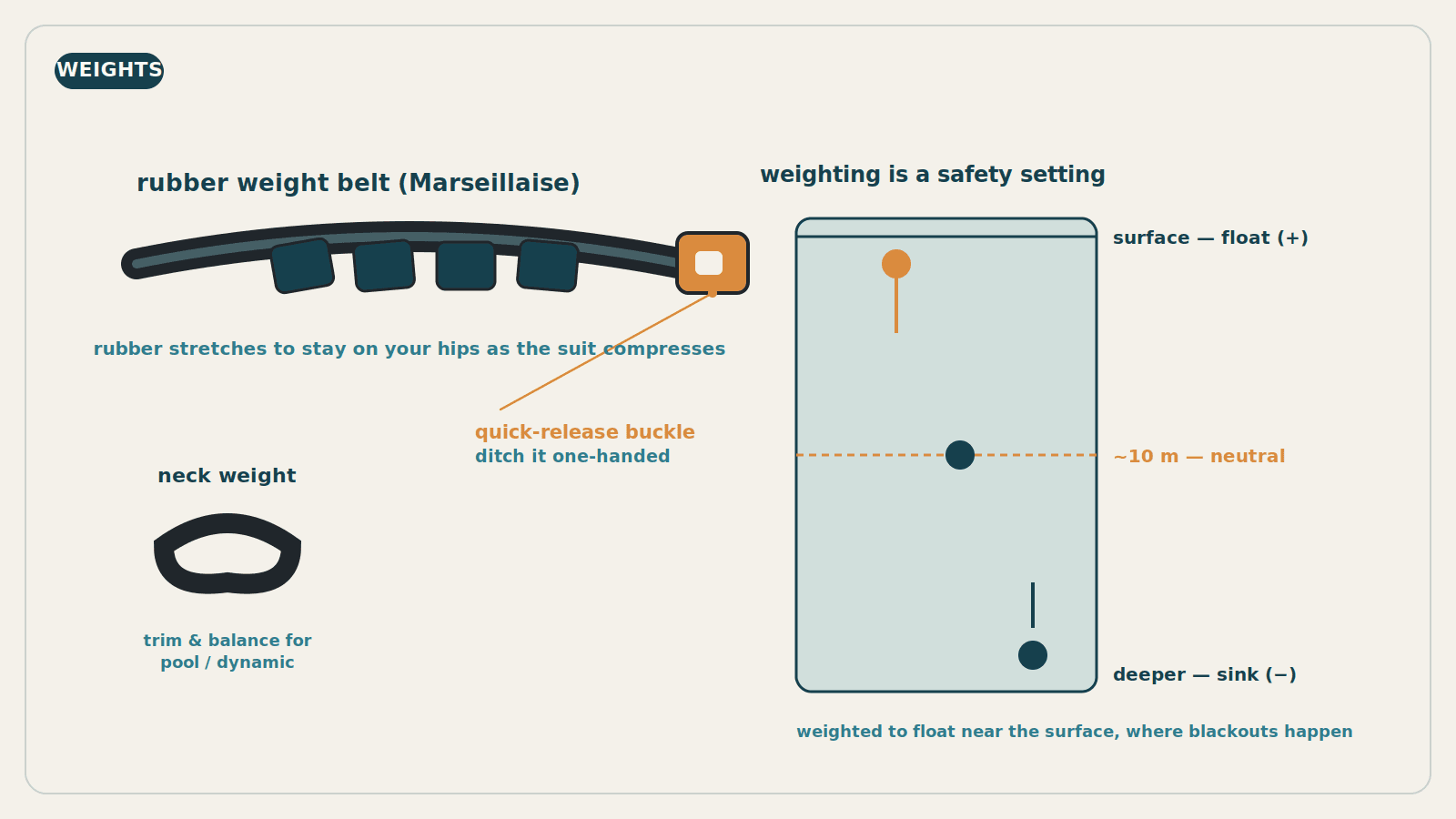
Neoprene floats, and so do you, so you carry lead to offset that buoyancy. Two details matter. First, use a rubber (silicone) weight belt, the Marseillaise style, rather than a nylon one — rubber stretches to stay on your hips as the wetsuit compresses with depth, instead of riding up to your chest. Second, it must have a quick-release buckle you can ditch one-handed in an emergency.
Weighting is a safety setting, not just a comfort one: the goal is to be neutrally buoyant around 10 meters, which leaves you positively buoyant (floating) near the surface, where blackouts happen and floating up is exactly what you want. For pool and dynamic disciplines, some divers add a neck weight to keep the body horizontal and balanced. Omer, Mares, and DiveR all make good rubber belts and soft weights.
A rubber belt with a quick-release buckle, and the buoyancy logic: weighted to float near the surface.
The line gear: lanyard and computer
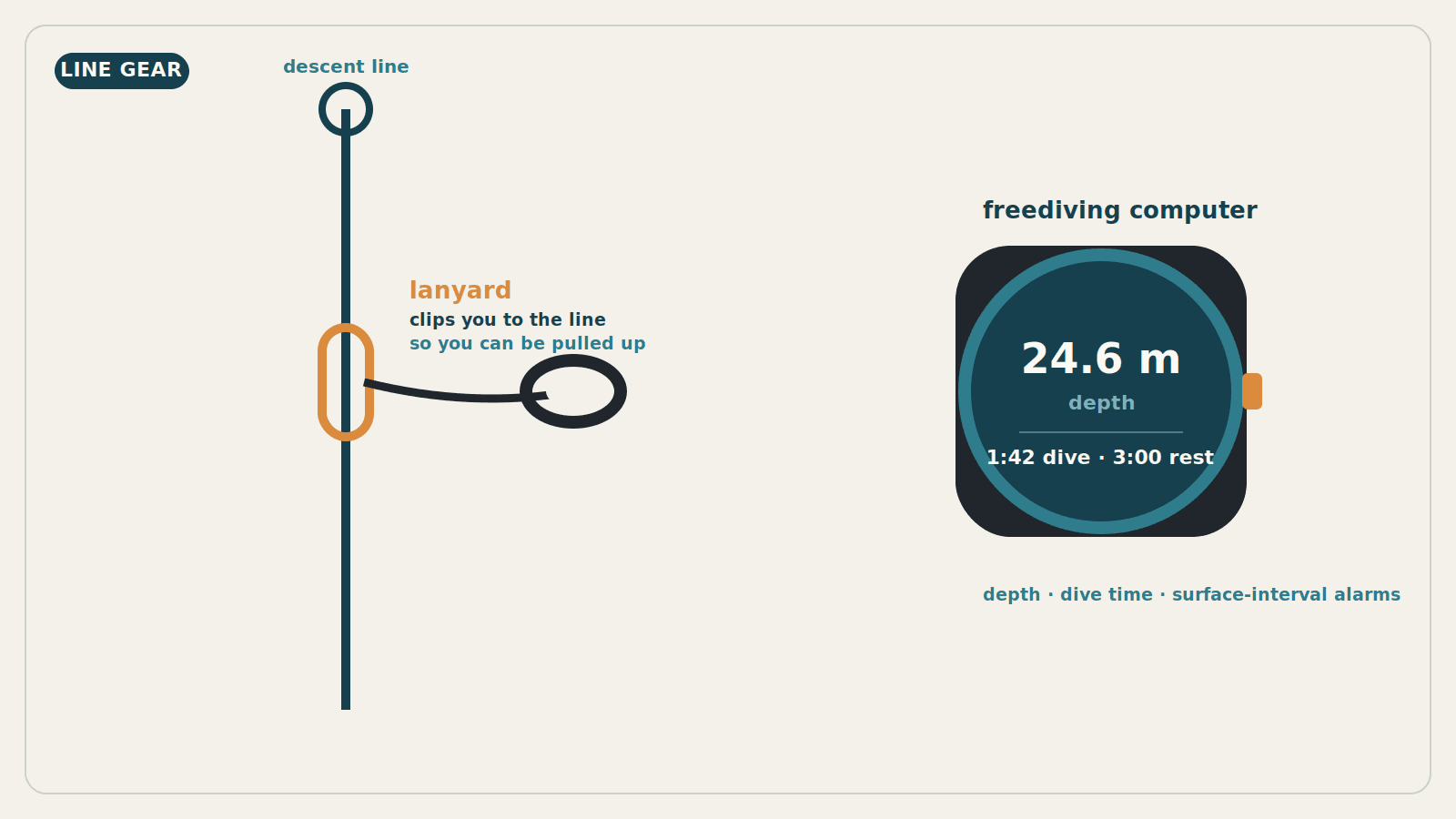
Once you're diving deep on a vertical line rather than just down to the reef, two more items appear. A lanyard clips you to the descent line so you stay on it and can be pulled up if needed — a core safety piece for depth training (Molchanovs and Oceaner are common). And a freediving dive computer tracks depth, dive time, and — critically — your surface-interval recovery between dives, often with alarms. Garmin (Descent series), Suunto (the D4F and Ocean), Mares, and Shearwater (whose Peregrine and Teric include freedive modes) are the names to know.
On a deep line: a lanyard tethers you to the rope, and a freediving computer tracks depth and recovery.
A note on brands
A useful distinction: brands like Cressi, Omer, Mares, Beuchat, and Salvimar are full-range freediving and spearfishing makers, while C4, DiveR, Leaderfins, and Molchanovs lean toward the higher-performance blades and depth-specific gear. Dive Rite, which you may also see recommended, is primarily a technical scuba and cave-diving brand rather than a freediving specialist — excellent kit, but aimed at a different sport, so don't expect long-blade fins or open-cell suits from them.
Where to start
If you're assembling a first kit, prioritize in this order: a well-fitting low-volume mask and simple snorkel, a pair of plastic or fiberglass long fins, then a wetsuit sized to your local water, and a rubber belt with weights dialed in with an instructor. Carbon fins, custom suits, lanyards, and a computer come later, as the depth — and the addiction — grows.